Explained: What is SS-31 (elamipretide)?
What SS-31 is, the membrane lipid it was built to find, the 2025 FDA decision behind the name elamipretide, and how it compares with MOTS-c.
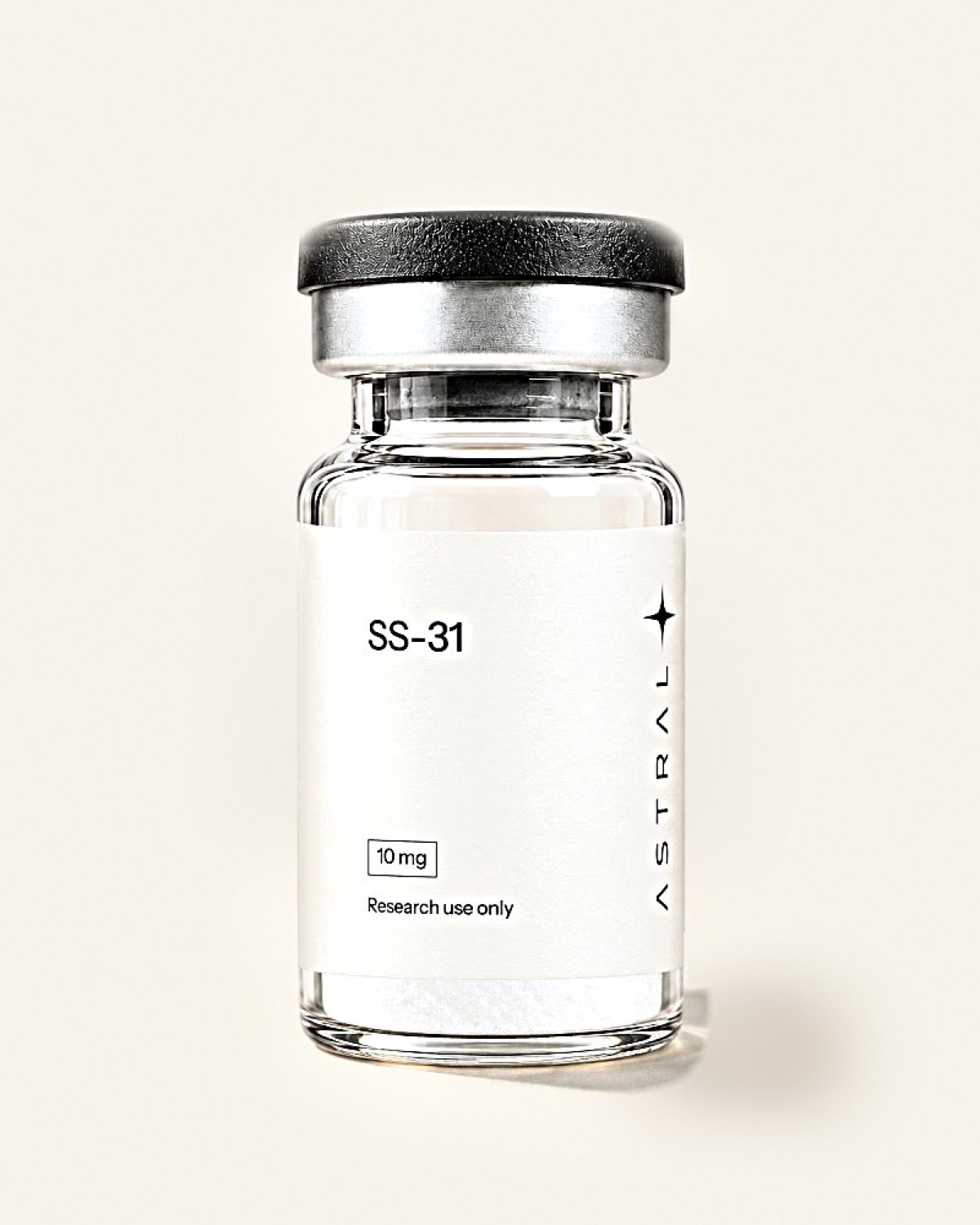
SS-31 is a synthetic peptide only four amino acids long, D-Arg-Dmt-Lys-Phe-NH₂, designed to slip inside cells, gather in the mitochondria and bind cardiolipin, a lipid in their inner membrane. It also goes by elamipretide, MTP-131 and, earlier, Bendavia. In September 2025, under the name elamipretide, it received FDA accelerated approval for Barth syndrome, the first approval for that disease. Astral lists SS-31 as a freeze-dried powder in a 10 mg vial, CAS 736992-21-5.
It often comes up in searches alongside MOTS-c and NAD+. Here is what it is, what it binds, what the approval covers, and how it differs from the others.
Table of contents
What SS-31 is at the molecular level
Four residues: D-arginine, 2′,6′-dimethyltyrosine (Dmt), lysine and phenylalanine, with the tail end capped as an amide. Two of them are unusual on purpose. The D form of arginine and the methylated tyrosine are not found in ordinary proteins, which helps the chain resist the enzymes that would otherwise chew it up. Molecular formula C32H49N9O5, molar mass 639.8 g/mol.
The sequence alternates positively charged residues with ring-shaped aromatic ones, so the literature calls it an aromatic-cationic peptide. That pattern lets it cross cell membranes on its own and collect at the inner mitochondrial membrane, at levels far above the rest of the cell. The “SS” stands for Szeto-Schiller, after Hazel Szeto and Peter Schiller, who designed the series it belongs to.
| Item | Value |
|---|---|
| Catalog name | SS-31 |
| Also known as | Elamipretide, MTP-131, Bendavia |
| Sequence | D-Arg-Dmt-Lys-Phe-NH₂ (Dmt = 2′,6′-dimethyltyrosine) |
| Length | 4 amino acids |
| CAS | 736992-21-5 |
| Molecular formula | C32H49N9O5 |
| Molar mass (MW) | 639.8 g/mol |
| Form | Lyophilized powder |
| Vial size | 10 mg |
What does SS-31 bind to?
Cardiolipin. It is a lipid found almost only in the inner membrane of mitochondria, where it holds the membrane’s folds in shape and anchors the machinery that turns fuel into usable energy. When cardiolipin is damaged, those folds lose their structure and the energy chain runs less cleanly.
A 2013 study in the Journal of the American Society of Nephrology reported that SS-31 binds cardiolipin and alters the activity of cytochrome c, a key carrier in that energy chain, in isolated kidney mitochondria after a loss of blood flow. Hazel Szeto’s 2014 review in the British Journal of Pharmacology pulled that line of work together and called SS-31 a first-in-class cardiolipin-protective compound.
Is SS-31 FDA-approved?
Yes, under the name elamipretide, for one disease. On September 19, 2025, the FDA granted accelerated approval for Barth syndrome, an ultra-rare inherited condition in which the body cannot finish building cardiolipin properly. The approval covers patients who weigh at least 30 kg, and the developer, Stealth BioTherapeutics, must run a further trial to confirm it.
The road there was uneven. A phase 3 trial in a broader group of inherited mitochondrial muscle diseases, MMPOWER-3, did not meet its main goals when it was published in Neurology in 2023. The Barth syndrome program, including a 168-week extension study published in Genetics in Medicine in 2024, is what carried the approval. Barth syndrome is a disorder of cardiolipin, the lipid SS-31 was built to bind.
SS-31 vs MOTS-c vs NAD+
All three come up in the same searches because all three involve mitochondria. They work at very different points, though. MOTS-c is a 16-amino-acid peptide that the mitochondria make themselves and send out as a signal. NAD+ is a coenzyme, a different kind of molecule from a peptide, that the energy chain runs on.
| SS-31 | MOTS-c | NAD+ | |
|---|---|---|---|
| What it is | Lab-designed peptide | Peptide from mitochondrial DNA | Coenzyme |
| Size | 4 amino acids | 16 amino acids | Dinucleotide |
| Where it acts | Inner mitochondrial membrane | Outside, as a signal | The cell’s energy reactions |
| FDA status | Approved 2025 (Barth syndrome) | Not approved | Not approved as a drug |
| Astral vial sizes | 10 mg | 10 mg, 40 mg | 1000 mg |
One way to keep them straight: SS-31 binds the inner membrane, NAD+ is a coenzyme the energy chain runs on, and MOTS-c is a signal peptide the mitochondria encode.
Storage and handling
Cold, dry, dark and sealed until use. Freeze-dried peptide keeps for years in a freezer and a year or two in a refrigerator, and the peptide storage guide has the full windows. Bring a cold vial to room temperature before opening it.
At 639.8 g/mol, a 10 mg vial holds about 15.6 micromoles, and a 1 mg/mL solution is about 1.56 millimolar. Mixed with Reconstitution Solution, it belongs in the refrigerator at 2 to 8 °C. The peptide calculator converts any vial and volume to mg/mL, and How to reconstitute peptides has the steps.
Common questions
Is SS-31 the same as elamipretide?
Yes. Elamipretide is the drug name for SS-31. MTP-131 and Bendavia are earlier development names for the same four-amino-acid peptide.
What does SS stand for in SS-31?
Szeto-Schiller, after the two researchers, Hazel Szeto and Peter Schiller, who designed the series of peptides it comes from.
Is SS-31 a peptide?
Yes, a tetrapeptide, meaning four amino acids. Two of them are modified forms, D-arginine and 2′,6′-dimethyltyrosine, which help it resist breakdown.
When was SS-31 approved by the FDA?
On September 19, 2025, as elamipretide, under accelerated approval for Barth syndrome in patients weighing at least 30 kg. It is not approved for any other use.
How is SS-31 different from MOTS-c?
SS-31 is a lab-designed peptide that works inside mitochondria, on cardiolipin in the inner membrane. MOTS-c is made by the mitochondria themselves and acts outside them, as a signal to other tissues.
How many micromoles are in a 10 mg vial of SS-31?
About 15.6. That is 0.010 grams divided by the molar mass, 639.8 g/mol. The peptide calculator handles the conversion for any volume you add.
Sources
- First-in-class cardiolipin-protective compound as a therapeutic agent to restore mitochondrial bioenergetics Szeto HH. British Journal of Pharmacology (2014)
- The mitochondrial-targeted compound SS-31 re-energizes ischemic mitochondria by interacting with cardiolipin Birk AV, Liu S, Soong Y, et al. Journal of the American Society of Nephrology (2013)
- Efficacy and Safety of Elamipretide in Individuals With Primary Mitochondrial Myopathy: The MMPOWER-3 Randomized Clinical Trial Karaa A, Bertini E, Carelli V, et al. Neurology (2023)
- Long-term efficacy and safety of elamipretide in patients with Barth syndrome: 168-week open-label extension results of TAZPOWER Thompson WR, Manuel R, Abbruscato A, et al. Genetics in Medicine (2024)
- FDA approves elamipretide HCl as first treatment for Barth syndrome Contemporary Pediatrics (2025)
- Elamipretide, compound summary PubChem, National Library of Medicine