Bacteriostatic water vs sterile water: which one for peptides?
What bac water actually is, how it differs from plain sterile water and saline, and why a multi-draw research vial pairs with a preserved reconstitution solution.
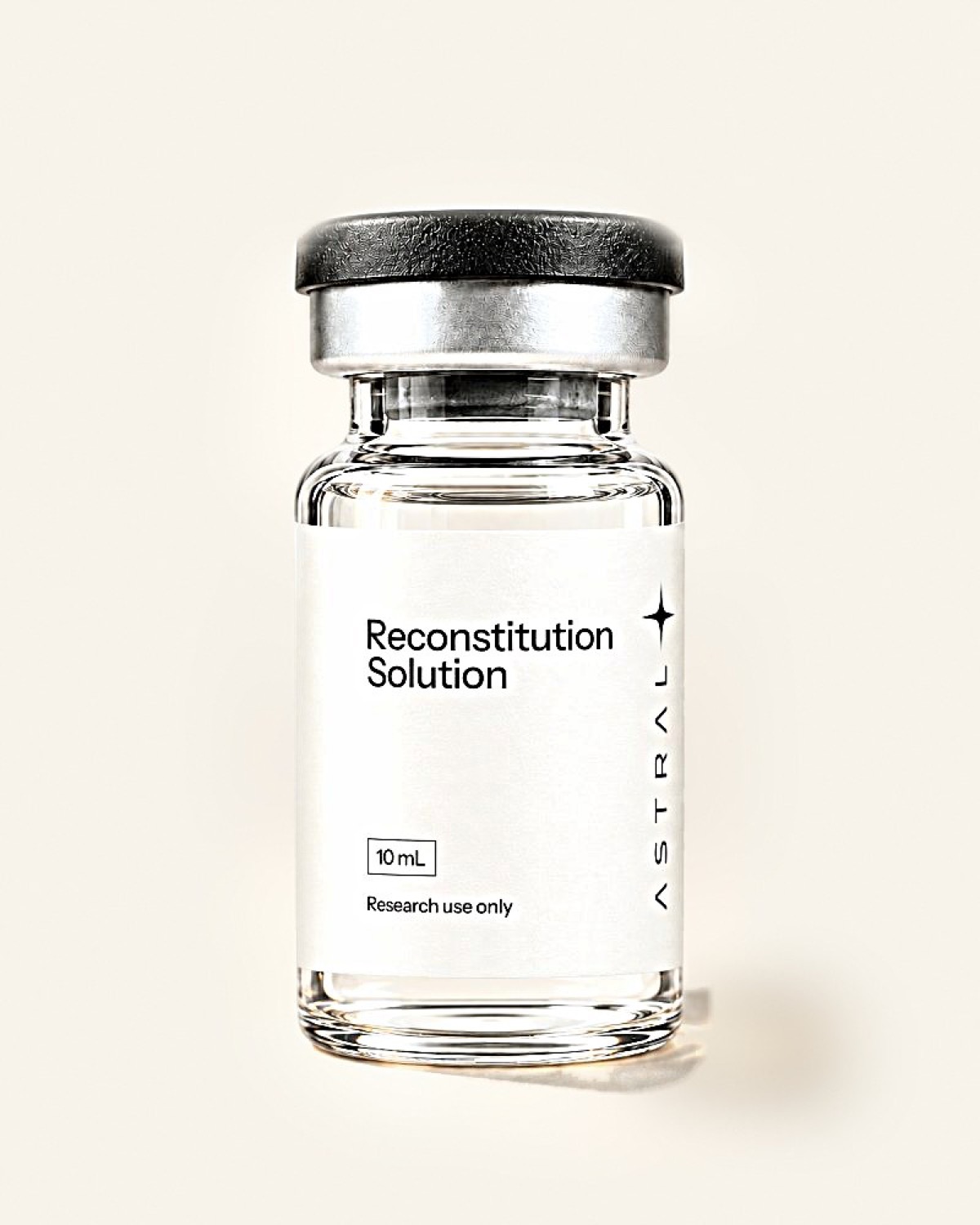
Bacteriostatic water is sterile water with 0.9% benzyl alcohol added as a preservative, and sterile water for injection is the same water with nothing added at all. That single ingredient is the whole difference. It decides whether a vial can be drawn from once or many times, how long it lasts after the first puncture, and which of the two a lab reaches for when a freeze-dried peptide needs to go back into solution.
Peptide labs call it bac water, suppliers call it a reconstitution solution, and the pharmacopeia calls it Bacteriostatic Water for Injection, USP. Astral’s Reconstitution Solution is that formulation, sterile water with 0.9% benzyl alcohol, in 10 mL and 30 mL vials. This guide is about the choice of solvent. The mixing itself is covered in our guide to reconstituting peptides.
Table of contents
What is bacteriostatic water?
The label on a vial of Bacteriostatic Water for Injection, USP describes a sterile, nonpyrogenic preparation of water for injection containing 0.9% (9 mg/mL) of benzyl alcohol, added as a bacteriostatic preservative. The pH sits at 5.7, within a permitted range of 4.5 to 7.0. It comes in a multiple-dose container from which repeated withdrawals may be made, and that is the operative phrase.
Bacteriostatic means what it says. The benzyl alcohol stops the few microbes that ride in on a needle from multiplying into a culture, and it keeps doing that for weeks. It is membrane-active, and a 2023 review in Pharmaceutics by Stroppel and colleagues describes it as increasing the fluidity of microbial membranes. A 2007 review in the Journal of Pharmaceutical Sciences found that phenol and benzyl alcohol are the two most common antimicrobial preservatives in licensed peptide and protein products, so this pairing has a long history behind it.
| Item | Value |
|---|---|
| Pharmacopeial name | Bacteriostatic Water for Injection, USP |
| Base | Sterile, nonpyrogenic water for injection |
| Preservative | Benzyl alcohol, 0.9% (9 mg/mL) |
| pH | 5.7 (4.5 to 7.0) |
| Container | Multiple-dose vial, repeated withdrawals |
| Unopened storage | 20 to 25 °C, out of the light |
| Opened vial | Dated, used within 28 days |
| Common names | Bac water, reconstitution solution |
Bacteriostatic water vs sterile water
Sterile Water for Injection, USP is also sterile, nonpyrogenic water for injection, and there the overlap ends. Its label states that it contains no bacteriostat, antimicrobial agent or added buffer, and that it is supplied only in single-dose containers to dilute or dissolve drugs for injection. The instruction that follows is short: discard unused portion. The pH range is 5.0 to 7.0, and both waters are stored at 20 to 25 °C.
So the comparison comes down to three things. The preservative, which one has and one lacks. The number of draws, many for the multiple-dose vial and one for the single-dose container. And the opened-vial window, 28 days for the preserved water and a single bench session for the plain water, because nothing in it will stop growth once the seal is broken.
| Bacteriostatic water | Sterile water | |
|---|---|---|
| Preservative | 0.9% benzyl alcohol | None |
| Container | Multiple-dose | Single-dose |
| Draws per vial | Repeated | One |
| After first puncture | Up to 28 days | Discard unused portion |
| Unopened storage | 20 to 25 °C | 20 to 25 °C, protect from freezing |
Plain sterile water still has a place. A few assays are sensitive to benzyl alcohol, and the Stroppel review notes that certain preservatives have been reported to increase particle formation in some protein and peptide formulations. When a compound’s technical sheet asks for unpreserved water, that is why. Mix what the session needs and let the rest go.
Bacteriostatic water vs saline, and dilute acetic acid
Two other solvents turn up in peptide work, and neither is a general substitute for bac water.
Normal saline is 0.9% sodium chloride in water. It is isotonic, which matters for cell-based assays and protocols written around physiological salt, but a single-dose saline vial has no preservative and follows the same single-session rule as sterile water. Salt also does nothing for solubility. A peptide that will not dissolve in water will not dissolve in saline either.
Dilute acetic acid answers that second problem, for a minority of sequences. Some peptides are strongly hydrophobic or prone to aggregating, and water is a poor solvent for them. A 2006 study in Protein Science by Malavolta and colleagues at the Federal University of São Paulo worked through model insoluble sequences, among them a fragment of amyloid-β, and found that water sat in the region of lowest dissociating power while solvents with a strong acid or base character pulled the aggregated chains apart. The same study recorded a sequence-dependent effect of pH on solubility. On the bench that means a weak acetic acid solution, often around 1%, used only when the technical sheet for that compound calls for it.
Which reconstitution solution do labs pick for freeze-dried peptides?
The preserved one, almost always. The reason is how research vials are used.
A research peptide arrives as a lyophilized powder, usually several milligrams in a vial, and that vial is rarely emptied in one sitting. It is reconstituted once and then drawn from over days or weeks, each draw a fresh puncture through the same stopper. Every puncture is a chance for something to get in. A solvent with no preservative turns that vial into a culture medium with a 24-hour clock on it, and a 10 mg vial of BPC-157 or GHK-Cu is too much material to discard after one day. The preserved solvent gives the mixed vial the same 28-day window the solvent vial itself has.
That is why the multi-draw research vial and the preserved solvent are a matched pair. Astral’s Reconstitution Solution is sterile water with 0.9% benzyl alcohol, the formulation commonly sold as bacteriostatic water, in a 10 mL vial for a handful of peptide vials and a 30 mL vial for a lab that mixes often. The peptide calculator turns a vial’s contents and the solvent volume into a concentration before the stopper is swabbed.
How long does bacteriostatic water last?
Unopened, until the expiration date printed on the vial, provided it has been kept at 20 to 25 °C.
Opened is where the 28 days come from. The United States Pharmacopeia’s General Chapter <797> on sterile compounding sets the beyond-use date for an opened multiple-dose container, and the Centers for Disease Control and Prevention relays it in plain terms: once a multiple-dose vial is punctured, date it and discard it within 28 days unless the manufacturer states another date for that opened vial. The beyond-use date can never run past the printed expiration date, so a vial opened three weeks before it expires has three weeks, not four.
Write the date of the first puncture on the vial itself. Memory is not a record.
Sterile water has no opened-vial window. The container is single-dose and the label says to discard the unused portion.
Storage and handling
The solvent and the mixed peptide live in different places. An unopened vial of bacteriostatic water or sterile water belongs on a shelf at 20 to 25 °C, out of direct light, and the sterile water label adds that it should be protected from freezing. Refrigerating a sealed solvent vial gains nothing, and a cold vial pulls condensation into a syringe the moment it is opened.
A reconstituted peptide is the opposite case. Once the powder is in solution, the reactions that freeze-drying held off are running again, and the mixed vial goes into the refrigerator at 2 to 8 °C from the first day. Our peptide storage guide covers the shelf life of powder and solution in detail, and the reconstitution guide walks through the mixing itself. If a vial of either water is cloudy or its seal is broken, both labels say the same thing: do not use it.
The solvent and the peptides it dissolves are both in the shop, and our guide on where to buy peptides covers what to look for in a supplier.
Common questions
Is bacteriostatic water the same as sterile water?
No. Both start as sterile water for injection, but bacteriostatic water carries 0.9% benzyl alcohol as a preservative and comes in a multiple-dose vial, while sterile water has no preservative and comes in a single-dose container that is discarded after one use.
Can you use sterile water for peptides?
Yes, for a solution that will be used within the same day. Without a preservative, a vial mixed with plain sterile water is a single-session vial. It is the right choice only when a technical sheet rules out benzyl alcohol.
How long does bacteriostatic water last after opening?
Twenty-eight days from the first puncture, dated on the vial, under USP <797> as relayed by the CDC, unless the manufacturer states a different date. It never extends past the printed expiration date.
Does bacteriostatic water need to be refrigerated?
Not before it is opened. The label calls for 20 to 25 °C. The peptide you mix with it is a different matter and goes into the refrigerator at 2 to 8 °C as soon as it is in solution.
What is the difference between bacteriostatic water and saline?
Saline is 0.9% sodium chloride in water, chosen for isotonic conditions. Bacteriostatic water is water with 0.9% benzyl alcohol, chosen so a vial can be drawn from repeatedly. Single-dose saline has no preservative, and salt does not improve solubility.
What is a peptide reconstitution solution?
It is the solvent used to return a freeze-dried peptide to liquid form. In practice the term almost always means sterile water with 0.9% benzyl alcohol, the formulation commonly sold as bacteriostatic water, which is what Astral’s Reconstitution Solution contains.
Sources
- BACTERIOSTATIC WATER injection, solution DailyMed, National Library of Medicine (2019)
- STERILE WATER- sterile water for injection injection, solution DailyMed, National Library of Medicine (2025)
- Preventing Unsafe Injection Practices Centers for Disease Control and Prevention
- Antimicrobial preservative use in parenteral products: past and present Meyer BK, Ni A, Hu B, Shi L. Journal of Pharmaceutical Sciences (2007)
- Antimicrobial Preservatives for Protein and Peptide Formulations: An Overview Stroppel L, Schultz-Fademrecht T, Cebulla M, et al. Pharmaceutics (2023)
- Interpretation of the dissolution of insoluble peptide sequences based on the acid-base properties of the solvent Malavolta L, Pinto MR, Cuvero JH, Nakaie CR. Protein Science (2006)