KLOW Peptide vs GLOW: What 10 mg of KPV Adds
KLOW is the GLOW blend with a fourth peptide, KPV, in the same vial. Here is what that adds, in milligrams and in plain words.
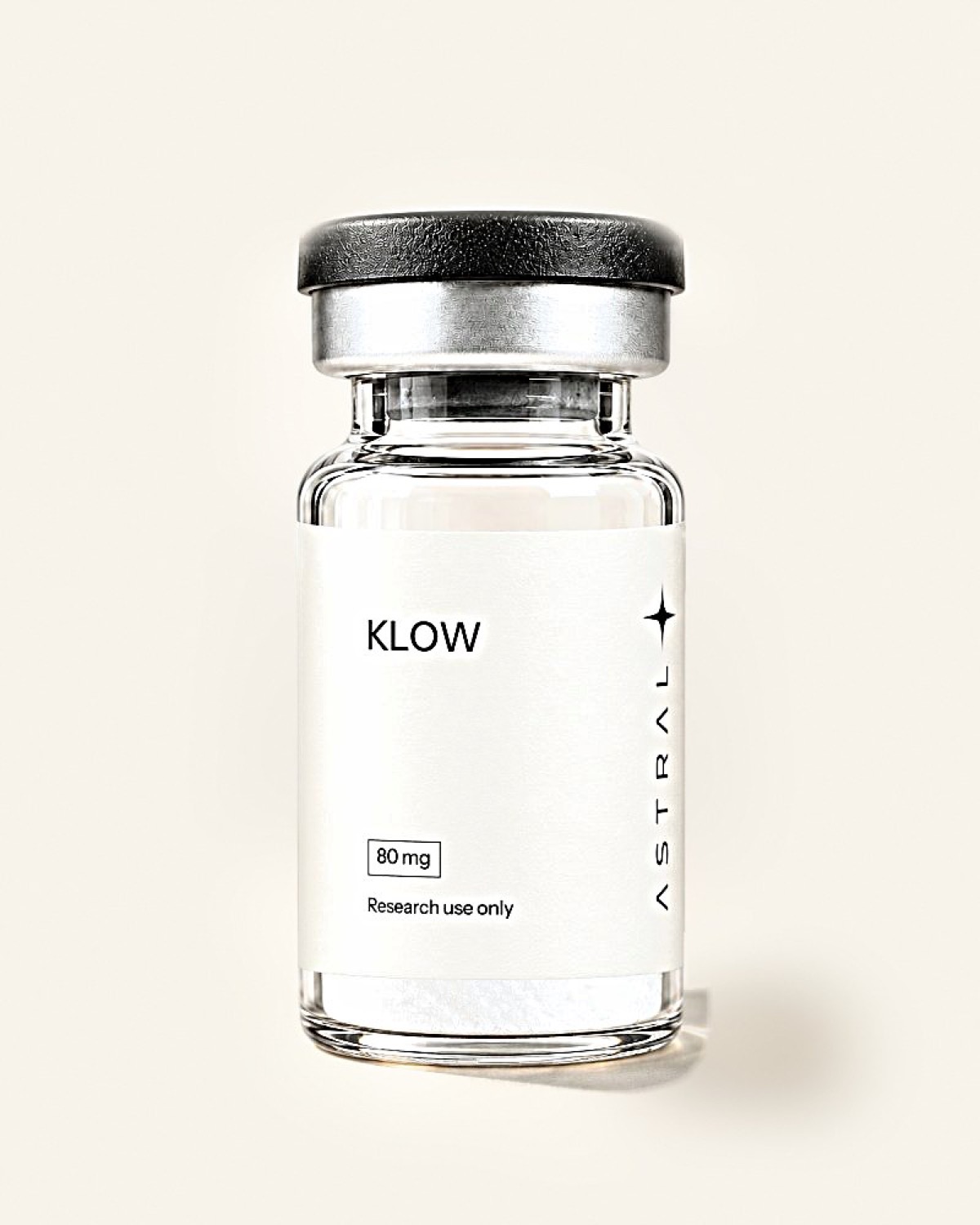
KLOW is GLOW with one more peptide in the vial. GLOW is three research peptides freeze-dried together, GHK-Cu, BPC-157 and TB-500, 70 mg in all. KLOW keeps those three at the same amounts and adds 10 mg of a fourth, KPV, so the vial comes to 80 mg, and those 10 mg of a peptide three amino acids long are the entire difference.
So “glow vs klow” shrinks to one question. Does your research design call for KPV in the same vial as the other three? If it does, KLOW. Otherwise GLOW. Below is what KPV is, what each vial holds, and the arithmetic once you add liquid. The longer story of GLOW itself, the 50/10/10 ratio and why the solution turns blue, lives in our GLOW explainer.
Table of contents
What is in KLOW vs GLOW, side by side?
KLOW holds GHK-Cu 50 mg, BPC-157 10 mg, TB-500 10 mg and KPV 10 mg, 80 mg per vial, and GLOW holds the first three at the same amounts for 70 mg. Each comes as one freeze-dried powder in a single vial, so the proportions are set when the vial is filled and cannot be adjusted afterward.
| Component | GLOW, 70 mg vial | KLOW, 80 mg vial |
|---|---|---|
| GHK-Cu | 50 mg | 50 mg |
| BPC-157 | 10 mg | 10 mg |
| TB-500 | 10 mg | 10 mg |
| KPV | none | 10 mg |
| Total | 70 mg | 80 mg |
Amounts are from Astral’s product records as of November 2026. GHK-Cu is most of either vial by weight, 50 of 70 mg in GLOW and 50 of 80 mg in KLOW, so adding the K brings in a fourth peptide while moving the total by only 10 mg.
What is KPV?
KPV is a peptide only three amino acids long, lysine, proline and valine, and amino acids are the building blocks every peptide is made of. The name is the one-letter code for those three, K, P and V, read in order. The same three sit at the tail end of alpha-MSH, a hormone the body makes that runs 13 amino acids in total, so KPV is that tail on its own, made in a lab. In the literature it is studied in inflammation research.
Astral also supplies KPV on its own, in a 10 mg vial, and that matters for the choice further down. Where KPV came from and what the colitis studies measured is in What is KPV peptide?.
What are GHK-Cu, BPC-157 and TB-500?
GHK-Cu is a three-amino-acid peptide with one copper ion attached. Cu is copper’s chemical symbol. We cover it in full in What is GHK-Cu, and it is in the catalog as a single compound at GHK-Cu. BPC-157 is a lab-made peptide of 15 amino acids. TB-500 is a lab-made peptide related to thymosin beta-4, a protein the body produces. The GLOW explainer walks through all three, one study each, so this page leaves them there. BPC-157 and TB-500 on their own, without the GHK-Cu, are the Wolverine blend, covered in our Wolverine peptide stack guide.
Should I pick KLOW or GLOW for a research design?
Pick KLOW when the design calls for KPV in the same vial as GHK-Cu, BPC-157 and TB-500, at a fixed 5:1:1:1 ratio by weight, and GLOW when KPV is no part of it. There is a third option. GLOW plus a separate vial of KPV suits a design that wants to hold the GLOW trio constant and vary the KPV amount from one arm of an experiment to the next, or leave it out of a control entirely. A blend is freeze-dried as one powder, so the KPV in KLOW cannot be dialed up or down.
How does the concentration math work for KLOW and GLOW?
Each peptide’s concentration is its own milligrams divided by the milliliters of liquid you add, so the four components of KLOW each get their own number. The liquid is called the solvent, and concentration is how much peptide ends up in each milliliter, written mg/mL. Take KLOW with 2 mL of Reconstitution Solution. GHK-Cu comes out at 25 mg/mL, since 50 over 2 is 25, and BPC-157, TB-500 and KPV come out at 5 mg/mL each, 10 over the same 2. The whole vial is 40 mg/mL. Every milliliter carries the four in the same 5:1:1:1 proportion as the dry powder, and when you change the volume every number scales together, so with 4 mL GHK-Cu lands at 12.5 mg/mL and the other three at 2.5 mg/mL.
This is arithmetic about what is in the vial. Our peptide calculator does the division one component at a time, so for GHK-Cu in KLOW you enter 50 as the vial contents, and for KPV you enter 10. The eight steps from a sealed vial to a clear solution are in How to reconstitute peptides.
How should KLOW and GLOW be stored?
Keep KLOW and GLOW sealed, cold, dry and dark until you mix them, then in the fridge at 2 to 8 °C from the moment the liquid goes in. Both are freeze-dried powders (the label says lyophilized), so they keep the way any other vial of that kind does, and the windows for freezer, fridge and shelf are laid out in our peptide storage guide.
What does KLOW stand for?
KLOW is commonly read as K plus GLOW, the K being KPV standing in front of the blend it was added to, which is a fair description of what is in the vial. In the Astral catalog GLOW came first. We cannot vouch for who coined either name or when, so take the reading as a memory aid.
How does Astral supply KLOW and GLOW?
KLOW ships as one 80 mg vial of freeze-dried powder labeled for research use only, and it is the newer of the two, launched in November 2026. GLOW ships as one 70 mg vial on the same terms, and KPV alone as a 10 mg vial. All three are made in the United States and leave from our own inventory in New York, with Standard, 2-Day and Overnight options shown at checkout for U.S. addresses. Current prices are in the catalog. Support is by email, and it does not expire with the order, so a question about a vial bought this month still gets answered next year.
If your design calls for the fourth peptide, see KLOW in the catalog.
KLOW, GLOW and KPV are supplied for laboratory research use only. Nothing on this page describes effects in people or animals, and the concentration arithmetic above describes the contents of a vial.
Common questions about KLOW and GLOW
Is KLOW the same as GLOW?
No. KLOW is GLOW plus 10 mg of KPV. Both hold GHK-Cu 50 mg, BPC-157 10 mg and TB-500 10 mg, so a KLOW vial weighs 80 mg and a GLOW vial 70 mg.
How many mg is a KLOW vial?
80 mg as of November 2026: 50 mg GHK-Cu, 10 mg BPC-157, 10 mg TB-500 and 10 mg KPV, freeze-dried together as one powder.
What are the KLOW peptide blend ingredients?
Four peptides. GHK-Cu, the copper-carrying one, is the bulk of the vial at 50 mg, followed by 10 mg each of BPC-157 (15 amino acids, lab-made), TB-500 (lab-made, related to thymosin beta-4) and KPV (the three-amino-acid tail of alpha-MSH). There is no fifth ingredient, and the vial holds no liquid until you add it.
Can I buy KPV separately?
Yes. Astral supplies KPV by itself in a 10 mg vial, which is the route to take when a design needs the GLOW trio with a KPV amount that can be set independently.
Can the KPV be separated out of KLOW?
No. The four peptides are freeze-dried together as one powder, and once liquid goes in they are one solution. If a design needs them apart, start from GLOW and a separate KPV vial, or from the four single compounds in the catalog.
Sources
- Alpha-melanocyte-stimulating hormone and related tripeptides: biochemistry, antiinflammatory and protective effects in vitro and in vivo, and future perspectives for the treatment of immune-mediated inflammatory diseases Brzoska T, Luger TA, Maaser C, et al. Endocrine Reviews (2008)
- PepT1-mediated tripeptide KPV uptake reduces intestinal inflammation Dalmasso G, Charrier-Hisamuddin L, Nguyen HT, et al. Gastroenterology (2008)
- Thymosin beta-4 Wikipedia (2026)