Retatrutide vs tirzepatide: how the two peptides differ
Two 39-amino-acid peptides from the same developer, one built for two receptors and one for three. A side-by-side of structure, receptors and where each stands.
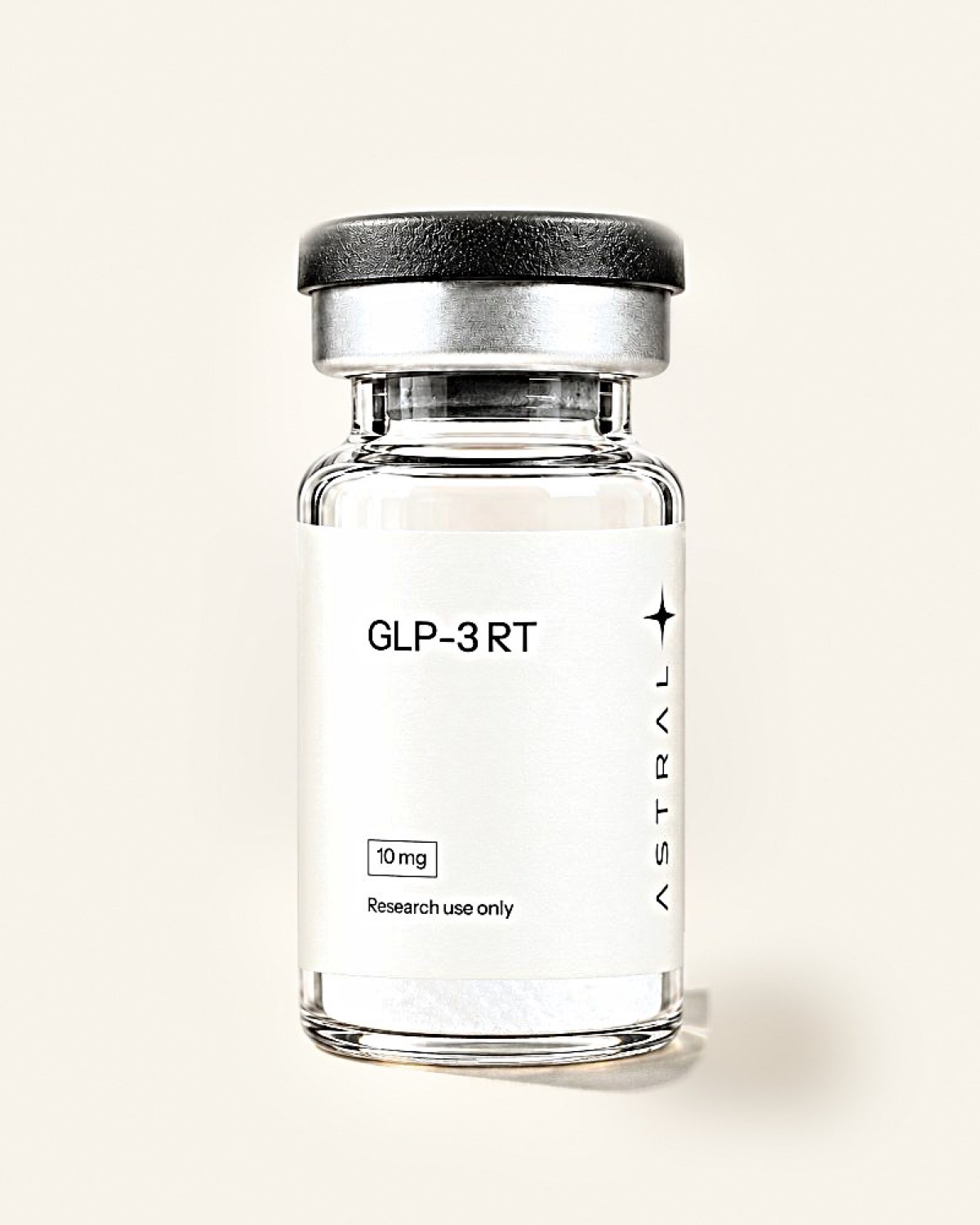
Tirzepatide acts on two hormone receptors, GIP and GLP-1. Retatrutide acts on those two plus a third, the glucagon receptor. Both are 39-amino-acid peptides developed by Eli Lilly, and both carry a fatty side chain that binds albumin. Tirzepatide is the active ingredient in approved prescription medicines. Retatrutide is still investigational. On a research label, tirzepatide is usually GLP-2 and retatrutide is GLP-3 RT.
That one added receptor is the whole story of the comparison. Here is how the two line up on structure, receptors, approval status and the trial that will compare them directly.
Table of contents
Retatrutide vs tirzepatide at a glance
| Tirzepatide | Retatrutide | |
|---|---|---|
| Developer code | LY3298176 | LY3437943 |
| Receptors | GIP and GLP-1 (dual agonist) | GIP, GLP-1 and glucagon (triple agonist) |
| Length | 39 amino acids | 39 amino acids |
| CAS | 2023788-19-2 | 2381089-83-2 |
| Molecular formula | C225H348N48O68 | C221H342N46O68 |
| Molar mass | 4813.45 g/mol | 4731.4 g/mol |
| Status, November 2026 | Approved in prescription medicines | Investigational, U.S. filing planned for early 2027 |
| Research label | GLP-2 | GLP-3 RT |
| Astral vial sizes | 10 mg | 10 mg, 20 mg, 30 mg |
What is the difference between retatrutide and tirzepatide?
The receptors. GIP and GLP-1 are hormones the gut releases after a meal, and their receptors sit on cells in the pancreas, the brain and elsewhere. Tirzepatide was built to switch on both. Lilly’s 2018 discovery paper in Molecular Metabolism introduced it as LY3298176, a single peptide with dual GIP and GLP-1 activity.
Retatrutide keeps both and adds the glucagon receptor. Glucagon is the hormone that raises blood sugar between meals, so adding it looks odd at first. Lilly’s 2022 paper in Cell Metabolism describes how the balance of activity across all three receptors was tuned. The literature calls tirzepatide a dual agonist and retatrutide a triple agonist on that basis.
How are retatrutide and tirzepatide built?
As close cousins. Both are 39-residue chains built from the same family of gut-hormone sequences, both include alpha-aminoisobutyric acid (Aib), an amino acid that does not occur in natural proteins and helps the chain resist breakdown, and both carry a fatty diacid side chain attached to a lysine through a short linker. That side chain binds albumin, the main carrier protein in blood plasma, and is the design feature behind each peptide’s long half-life.
The differences are in the details. Tirzepatide’s fatty chain hangs off lysine 20, retatrutide’s off lysine 17, and retatrutide carries other non-natural residues, alpha-methyl-leucine among them, that tirzepatide lacks. Our retatrutide guide covers its structure in more depth.
Is retatrutide stronger than tirzepatide?
Measured in separately run trials, retatrutide’s highest dose has produced larger average weight reductions than tirzepatide’s, but different trials enroll different people and run for different lengths of time, so the numbers do not line up cleanly.
The direct comparison is under way. TRIUMPH-5, registered as NCT06662383, enrolled an estimated 800 adults to compare retatrutide with tirzepatide over 80 weeks, with percent change in body weight as its main measure. ClinicalTrials.gov lists data collection finishing in late 2026, and no results had been posted as of November 2026.
Where do retatrutide and tirzepatide stand with the FDA?
Tirzepatide is the active ingredient in prescription medicines the FDA approved for type 2 diabetes in 2022, chronic weight management in 2023 and obstructive sleep apnea in adults with obesity in 2024. Retatrutide is not approved. Lilly reported results from several phase 3 trials in 2025 and 2026 and says it plans to file for U.S. approval in the first quarter of 2027.
Retatrutide vs tirzepatide vs semaglutide
Semaglutide is the one-receptor member of the family, a GLP-1 receptor agonist of 31 amino acids, and on research labels it is usually GLP-1. The family steps up one receptor at a time: semaglutide one, tirzepatide two, retatrutide three. Tirzepatide and semaglutide have already been compared directly, most recently in SURMOUNT-5, published in the New England Journal of Medicine in 2025. Our GLP-1, GLP-2 and GLP-3 RT guide explains how the label names map to the three compounds.
Storage and handling
Both arrive as freeze-dried powder and keep the same way: cold, dry, dark and sealed, with years of life in a freezer and a year or two in a refrigerator. The peptide storage guide has the windows. Once mixed with Reconstitution Solution, either belongs in the refrigerator at 2 to 8 °C, and the peptide calculator turns milligrams and milliliters into a concentration.
Common questions
What is the main difference between retatrutide and tirzepatide?
One receptor. Tirzepatide acts on the GIP and GLP-1 receptors. Retatrutide acts on those two plus the glucagon receptor.
Have retatrutide and tirzepatide been compared head to head?
Yes, in TRIUMPH-5, which enrolled an estimated 800 adults for 80 weeks. Its results had not been posted as of November 2026.
Is GLP-2 the same as tirzepatide?
On a research label, yes. GLP-2 is the catalog name for tirzepatide, with the 2 counting its two receptors. It has nothing to do with the natural GLP-2 hormone.
Is GLP-3 the same as retatrutide?
Yes. GLP-3 RT is the catalog name for retatrutide, with the 3 counting its three receptors. No natural hormone is called GLP-3.
Is retatrutide FDA-approved?
No. As of November 2026 it is investigational, and Lilly plans to file for U.S. approval in early 2027.
What do LY3298176 and LY3437943 mean?
They are Eli Lilly’s development codes. LY3298176 is tirzepatide and LY3437943 is retatrutide, used in early papers and trial registrations before the generic names were assigned.
Sources
- LY3298176, a novel dual GIP and GLP-1 receptor agonist for the treatment of type 2 diabetes mellitus: From discovery to clinical proof of concept Coskun T, Sloop KW, Loghin C, et al. Molecular Metabolism (2018)
- LY3437943, a novel triple glucagon, GIP, and GLP-1 receptor agonist for glycemic control and weight loss: From discovery to clinical proof of concept Coskun T, Urva S, Roell WC, et al. Cell Metabolism (2022)
- Tirzepatide Once Weekly for the Treatment of Obesity Jastreboff AM, Aronne LJ, Ahmad NN, et al. New England Journal of Medicine (2022)
- Triple-Hormone-Receptor Agonist Retatrutide for Obesity: A Phase 2 Trial Jastreboff AM, Kaplan LM, Frias JP, et al. New England Journal of Medicine (2023)
- Tirzepatide as Compared with Semaglutide for the Treatment of Obesity Aronne LJ, Horn DB, le Roux CW, et al. New England Journal of Medicine (2025)
- A Study of Retatrutide (LY3437943) Compared to Tirzepatide (LY3298176) in Adults Who Have Obesity (TRIUMPH-5) ClinicalTrials.gov (2024)
- Lilly’s triple agonist, retatrutide, successful in two additional Phase 3 obesity trials Eli Lilly and Company (2026)