Explained: How to reconstitute peptides?
What you need, how to pick a solvent, and the eight steps from a sealed vial to a clear solution, plus how to keep it once it’s mixed.
Most research peptides ship as a lyophilized, or freeze-dried, powder. They keep far better that way, but before the material can be measured or used it has to go back into solution. That step is reconstitution, and it’s where a lot of good material gets spoiled: a stream of solvent fired straight at the powder, a vial shaken hard, a stopper pierced without a swab.
None of it is difficult. Done the same careful way every time, it takes about ten minutes and leaves you with a clean solution at a concentration you actually know. The steps below work for every lyophilized compound in the catalog, from single peptides like BPC-157 and GHK-Cu to blends like Wolverine and GLOW.
Table of contents
Why technique matters
Peptides are fragile chains. Mechanical stress, whether that’s a hard stream onto the powder, vigorous shaking or a vial full of foam, can make them clump together or lose their structure, and that damage doesn’t undo itself once the vial settles. Contamination is the other risk: every puncture of the stopper is a chance to introduce something you didn’t mean to study. Good technique is mostly about avoiding both.
What you’ll need
- The sealed peptide vial, stored the way its label and certificate describe.
- A solvent, usually bacteriostatic water (more on choosing one below).
- Sterile 1 mL syringes with fine 27–29 gauge needles, for measuring small volumes precisely.
- Alcohol prep pads for the stoppers.
- A sharps container for used needles.
- Labels and a pen, plus your lab notebook.
Optional, but handy: the peptide calculator, which turns vial contents and solvent volume into a concentration before you start.
Choosing a solvent
The solvent is the first decision, because everything after it depends on it. The short version is below, and bacteriostatic water vs sterile water has the long one.
Bacteriostatic water
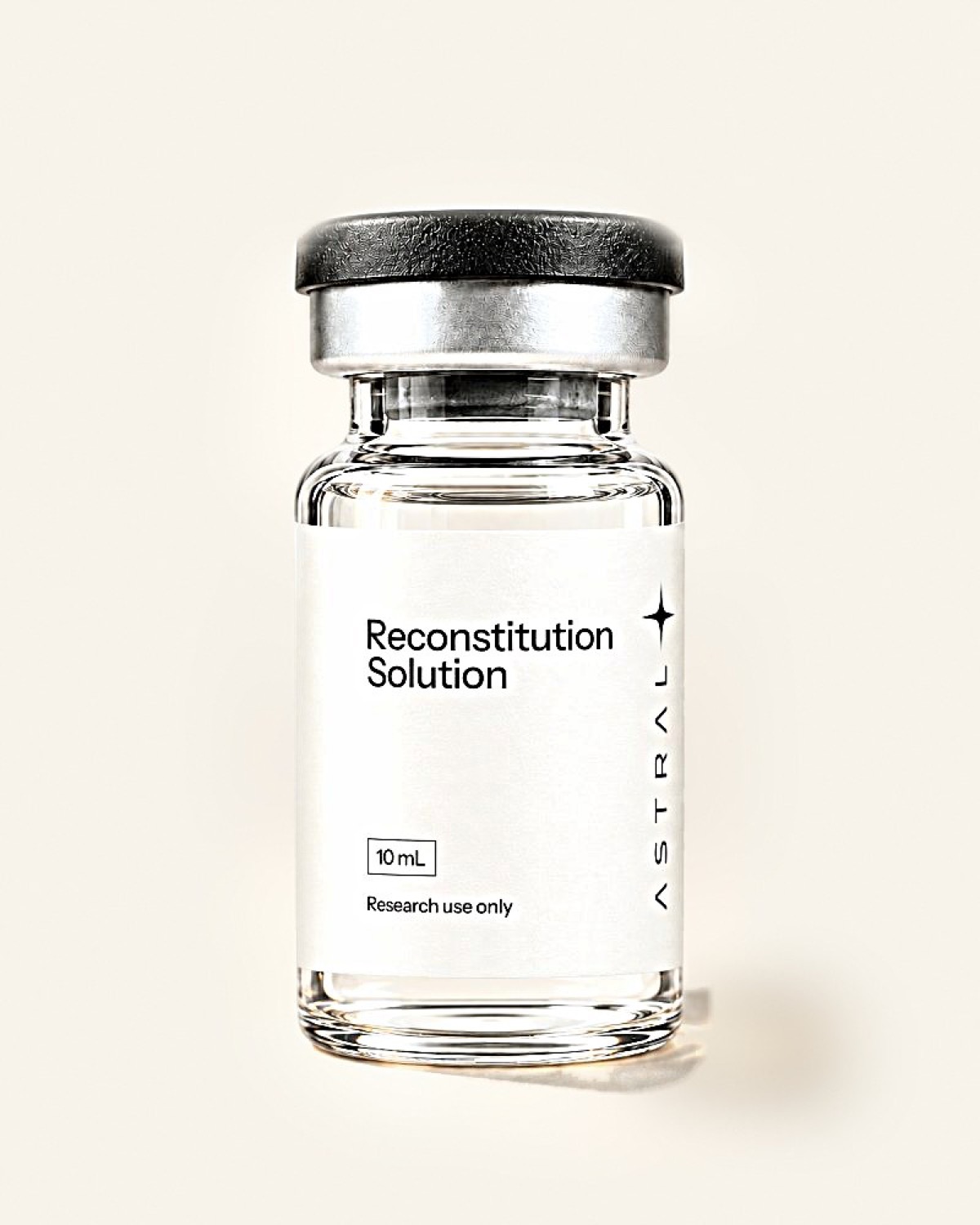
Sterile water with 0.9% benzyl alcohol added as a preservative. The preservative is what lets you go back into the same vial over several weeks; a multi-use vial is commonly kept for up to 28 days, refrigerated, after it’s first punctured. It’s the default for most lyophilized peptides. Astral’s Reconstitution Solution is water with 0.9% benzyl alcohol, in 10 mL and 30 mL vials.
Sterile water
Plain sterile water with no preservative. It suits a single use: once opened, use it within about 24 hours and discard the rest. It’s also the choice when benzyl alcohol could interfere with a particular assay.
Saline and dilute acetic acid
Normal saline (0.9% sodium chloride) turns up in protocols that need isotonic conditions, but it isn’t a general default. Dilute acetic acid, around 1%, is kept for the few sequences that won’t stay dissolved at neutral pH. Use it only when the compound’s technical sheet calls for it.
Step by step
1. Set up a clean workspace
Clear a flat surface, wipe it down, and wash your hands or put on nitrile gloves. Lay everything out before you open anything, so the vials spend as little time as possible exposed to the room.
2. Let the vial come to room temperature
If the vial has been in the freezer or the fridge, leave it on the bench, still sealed, for 15 to 20 minutes. Don’t try to warm it faster. A cold vial opened straight away pulls condensation inside, and moisture is exactly what freeze-drying took out.
3. Decide how much solvent to add
The volume you add sets the concentration, and there’s no single right answer: choose a concentration that’s easy to measure for your work. The arithmetic is simple. Concentration in mg/mL is the peptide in the vial, in mg, divided by the solvent you add, in mL.
| Peptide in the vial | Solvent added | Concentration |
|---|---|---|
| 5 mg | 1 mL | 5 mg/mL (5,000 mcg/mL) |
| 5 mg | 2 mL | 2.5 mg/mL (2,500 mcg/mL) |
| 10 mg | 1 mL | 10 mg/mL (10,000 mcg/mL) |
| 10 mg | 2 mL | 5 mg/mL (5,000 mcg/mL) |
| 20 mg | 2 mL | 10 mg/mL (10,000 mcg/mL) |
| 50 mg | 2 mL | 25 mg/mL (25,000 mcg/mL) |
The peptide calculator does this for any vial and shows where a given volume sits on a 0.3, 0.5 or 1 mL syringe.
4. Swab both stoppers
Wipe the rubber stopper on the peptide vial and on the solvent vial with an alcohol pad, then give them about ten seconds to air-dry. Piercing a wet stopper carries alcohol into the vial, and skipping the swab altogether is how contamination usually gets in.
5. Draw the solvent
With a fresh sterile syringe, draw the volume you settled on from the solvent vial. Tap the barrel to bring any air bubbles to the top and press them out until a small bead shows at the needle tip, then check the volume against the markings once more.
6. Add it down the side of the vial
This is the step that matters most. Push the needle through the peptide vial’s stopper at an angle so the tip rests against the glass, then press the plunger slowly. Let the solvent run down the inside wall and pool at the bottom. Never aim the stream at the powder; its force alone is enough to damage the peptide.
Many vials are sealed under a slight vacuum and will start drawing the solvent in on their own. Let them, and keep the stream on the glass.
7. Swirl, don’t shake
Roll the vial gently between your fingers, or swirl it in slow circles, until the powder is gone, usually 30 seconds to a minute. Shaking whips the solution into foam and puts exactly the kind of stress on the peptide you’re trying to avoid. If foam does form, set the vial down and give it a few minutes to settle.
GHK-Cu is the one to expect color from: a blue tint is normal, and it comes from the copper in the complex.
8. Check the solution and label it
Hold the vial up to the light. It should be clear, with no cloudiness, specks or film, no powder left at the bottom and no lingering foam. If it stays cloudy or won’t dissolve fully, don’t use it; that points to degradation, contamination or the wrong solvent.
Then label it with the compound, the concentration, the solvent and the date, and copy the lot number into your lab notebook, so the solution can always be traced back to its certificate.
Storing it afterward
Once it’s in solution, a peptide is far less stable than it was as a powder.
- Refrigerate it right away, at 2–8 °C.
- With bacteriostatic water, plan to use it within about 28 days of the first puncture.
- Keep it out of the light, in its carton or an opaque box.
- Don’t freeze and thaw the same vial. For longer storage, split the solution into single-use aliquots, freeze those, and thaw each one only once.
- Use a fresh sterile syringe every time you go back into the vial.
Common mistakes
Spraying solvent onto the powder
The most common one by far. Running the solvent down the glass in step 6 isn’t optional.
Shaking the vial
Swirling dissolves the powder just as well, without the foam.
Opening a cold vial
Condensation gets in and the powder dissolves unevenly. Give it the full 15 to 20 minutes.
Using too little solvent
A very concentrated solution leaves you measuring tiny volumes, where a small error becomes a large one.
Picking the wrong solvent
Most compounds are fine in bacteriostatic water, but check the technical sheet for anything unusual.
Reusing syringes
Every needle that goes into the vial should be a fresh, sterile one.
Common questions
Can I use sterile water instead of bacteriostatic water?
Yes, but without a preservative the solution is good for about a day. If you’ll be going back into the vial over several sessions, bacteriostatic water is the better choice.
How do I know if a reconstituted peptide has gone bad?
Look for cloudiness, particles, a change in color (GHK-Cu’s blue aside) or an unusual smell. Any of those means it’s time to discard it and mix a fresh vial. A note of how the solution looked on the day you made it gives you something to compare against.
Can I freeze a reconstituted peptide?
You can, in single-use aliquots. Freeze each portion once and thaw it once; repeated freezing and thawing does more harm than steady refrigeration.
Why is my peptide slow to dissolve?
Larger peptides and stronger concentrations simply take longer. Keep swirling gently for two or three minutes and let the vial rest at room temperature. If it still won’t clear, a little more solvent usually helps; just recalculate the concentration afterward.
What needle should I use?
A 1 mL syringe with a 27–29 gauge needle is the usual choice. The fine needle gives precise control at small volumes and is less likely to core the rubber stopper.
Tools & records
The peptide calculator turns a vial’s contents and a solvent volume into a concentration before you mix. Afterward, the COA library holds the Certificate of Analysis for each released lot, so the lot number you copied into your notebook can be matched to its record.
Astral supplies these materials for laboratory research only. These steps describe bench handling of research material.