GLP-1, GLP-2, GLP-3 RT: what research peptide names mean
The number counts receptors and the letters shorten a name. One of the three labels also belongs to a gut hormone that has nothing to do with the vial.
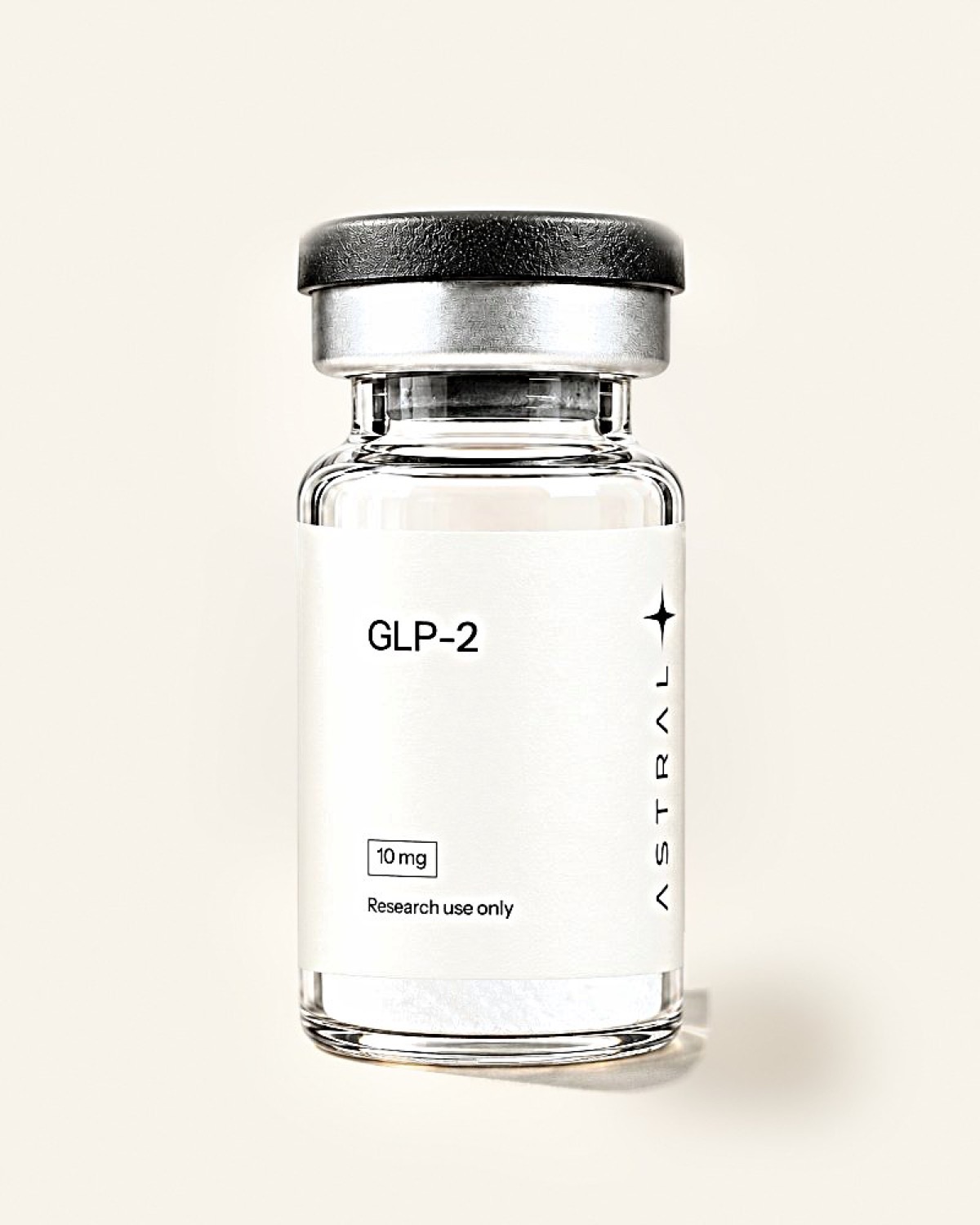
On a research peptide label, GLP-1 almost always means semaglutide, GLP-2 means tirzepatide, and GLP-3 RT means retatrutide. The number counts how many hormone receptors the compound acts on, and any letters after it shorten the generic name.
GLP-1 and GLP-2 are also the names of two real hormones your gut makes every day, and the real GLP-2 hormone has nothing to do with tirzepatide. Type “GLP-2 peptide” into Google and most of what comes back describes that gut hormone, none of which helps you read a vial.
Table of contents
What do GLP-1, GLP-2 and GLP-3 mean on a research peptide label?
In research catalogs, Astral’s included, the number after GLP counts the receptors the compound acts on, so GLP-1 is semaglutide, which acts on one, GLP-2 is tirzepatide, which acts on two, and GLP-3 RT is retatrutide, which acts on all three.
A receptor is a docking site on the outside of a cell, shaped to fit one particular hormone. Three hormones matter here. GLP-1 is made by cells in the gut wall, GIP by a different set of gut cells, and glucagon by the pancreas. Each has its own receptor.
Semaglutide is a modified copy of the GLP-1 hormone and fits its receptor. Tirzepatide was built on the GIP hormone’s pattern instead and fits both the GIP receptor and the GLP-1 receptor. Retatrutide also started from the GIP pattern and fits those two plus the glucagon receptor. That is where the three comes from.
The letters after the number shorten the generic name, which is why the RT in GLP-3 RT stands for retatrutide. None of this is official. Many research catalogs count receptors this way, but no regulator or textbook does, and a few catalogs invent codes of their own. A catalog name is a nickname, so when it matters, confirm the generic name behind it.
Is the GLP-2 peptide the same as tirzepatide?
On a research vial, yes, GLP-2 almost always means tirzepatide. The biology says no. GLP-2 is also a real hormone, a chain of 33 amino acids made by cells lining the small intestine and colon, cut from the same parent molecule that gives the body GLP-1 and glucagon.
That hormone has nothing to do with tirzepatide. Tirzepatide acts on the GIP and GLP-1 receptors. The GLP-2 hormone has a receptor of its own and a job of its own in the gut, and there is already a prescription medicine, teduglutide, that is a modified copy of it. When a search for “GLP-2 peptide” returns pages about the intestine, that is the hormone you are reading about, and none of it describes the compound in the vial.
GLP-1 carries the same double meaning, with one difference. GLP-1 is a hormone too, and semaglutide is a modified copy of that very hormone, so the catalog name and the biology at least point the same way. GLP-3 has no twin. People make no hormone by that name. The human gene behind glucagon, GLP-1 and GLP-2 stops there, and when biologists did find a GLP-3, it was in the elephant shark. On a label, then, GLP-3 can only mean the catalog compound.
How do you decode codes like RT-10, RT 20 or G2-T?
Most of these codes pair a short form of the compound’s name with the milligrams of powder in the vial, so RT-10 usually reads as retatrutide, 10 mg, and RT 20 as retatrutide, 20 mg. A code like G2-T most likely points at the “GLP-2” compound, tirzepatide, with the T spelling out the name.
Those readings are the common ones. That is as far as anyone can honestly go, because every catalog picks its own codes, some keep them private, and we will not guess at another seller’s shorthand.
For any label, ask for the generic name: semaglutide, tirzepatide or retatrutide. A seller who cannot name one of those three has not told you what you are buying. If the paperwork lists a CAS number, match that instead. A CAS number is a registry number assigned to one chemical substance, so it works like a serial number for the molecule and pays no attention to whatever nickname is printed above it.
| Generic name | CAS number |
|---|---|
| Semaglutide | 910463-68-2 |
| Tirzepatide | 2023788-19-2 |
| Retatrutide | 2381089-83-2 |
Is GLP-3 RT the same as retatrutide?
Yes. On Astral, GLP-3 RT is retatrutide, the compound Eli Lilly developed under the code LY3437943. The 3 stands for the three receptors it acts on and the RT for retatrutide. You may also see it written as RT-3 or 3RT, and all of those point at the same 39-amino-acid chain.
As of November 2026, retatrutide is still under study, with no approved medicine behind it, which is part of why the catalog nicknames are the words people end up typing. Our retatrutide guide covers the compound itself in more depth, and retatrutide vs tirzepatide lines it up against the GLP-2 compound.
Is tirzepatide a peptide? Is semaglutide?
Yes, both are peptides, and so is retatrutide. A peptide is a short chain of amino acids, the same building blocks that make up proteins, and the usual cutoff is about 50: shorter chains are called peptides, longer ones polypeptides, and proteins are built from those. Semaglutide, the compound behind Astral’s GLP-1, is 31 amino acids long. Tirzepatide and retatrutide are 39 each. All three are modified versions of natural hormone patterns, with a few building blocks swapped and a long carbon chain attached at one point along the sequence.
Semaglutide and tirzepatide are also the active ingredients in approved prescription medicines, which are finished products made and sold under prescription rules. A research vial is a different article, supplied as raw material for laboratory work, and this page describes the molecules only.
How do GLP-1, GLP-2 and GLP-3 RT compare?
The three compounds are cousins. Each is a modified copy of a gut-hormone pattern, and they differ mainly in how many receptors they act on and who developed them.
| Catalog name | Generic name | Developer and code | Receptors | Astral vial sizes |
|---|---|---|---|---|
| GLP-1 | Semaglutide | Novo Nordisk, NNC 0113-0217 | GLP-1 | 10 mg |
| GLP-2 | Tirzepatide | Eli Lilly, LY3298176 | GIP and GLP-1 | 10 mg |
| GLP-3 RT | Retatrutide | Eli Lilly, LY3437943 | GIP, GLP-1 and glucagon | 10, 20 or 30 mg |
Vial sizes are as of November 2026.
How does Astral supply GLP-1, GLP-2 and GLP-3 RT?
Astral stocks all three as lyophilized powder, which means freeze-dried, in sealed vials labeled for research use: GLP-1 (semaglutide) in 10 mg, GLP-2 (tirzepatide) in 10 mg, and GLP-3 RT (retatrutide) in 10, 20 and 30 mg. Every compound is made in the United States and ships from our own inventory in New York. At checkout, U.S. orders choose Standard, 2-Day or Overnight delivery, some international destinations are available as well, and prices and delivery options are shown in the catalog and at checkout.
Freeze-dried powder needs a solvent before it can go to work on the bench. We stock Reconstitution Solution, sterile water with 0.9% benzyl alcohol, and the peptide calculator does the concentration arithmetic once you know the vial’s milligrams and the volume you are adding. Every customer gets lifetime support for their compounds by email, so if a label or a code ever leaves you unsure, ask us before you order.
Frequently asked questions
What is GLP-3 RT?
GLP-3 RT is the research-catalog name for retatrutide, a 39-amino-acid peptide developed by Eli Lilly that acts on the GIP, GLP-1 and glucagon receptors. The 3 counts those receptors and RT shortens retatrutide.
Is RT-3 the same as retatrutide?
Yes. RT-3, 3RT and GLP-3 RT are all nicknames for retatrutide, and the generic name on the paperwork or the CAS number in the table above is what confirms it.
What does the number after a code mean, as in RT-10 or RT 20?
Usually the milligrams of powder in the vial, so RT-10 is typically a 10 mg vial of retatrutide. Check the net quantity printed on the label, because the code is only a nickname.
Why does searching “GLP-1 peptide” show a hormone and a medicine?
Because GLP-1 is a hormone first. Semaglutide is a modified copy of it, that same semaglutide is the active ingredient in several prescription medicines, and research catalogs borrowed the hormone’s name as a label, so the one word now covers a hormone, a medicine and a catalog listing.
How should I store a vial once it arrives?
Cold, dry, dark and sealed. Lyophilized powder keeps far longer than mixed solution, and the storage guide gives the time windows for freezer, refrigerator and room temperature.
Where can I get GLP-1, GLP-2 and GLP-3 RT for research?
All three are in the Astral catalog under exactly those names, so the label you receive matches this page. See GLP-1, GLP-2 and GLP-3 RT in the catalog.
Astral supplies GLP-1, GLP-2 and GLP-3 RT for laboratory research only. This guide explains the names on the label and describes the molecules as research material.
Sources
- PubChem Compound Summary for CID 56843331, Semaglutide National Library of Medicine (2026)
- PubChem Compound Summary, Tirzepatide National Library of Medicine (2026)
- PubChem Substance Record SID 474492335, Retatrutide National Library of Medicine (2026)
- PubChem Compound Summary for CID 16139605, Teduglutide National Library of Medicine (2026)
- Tirzepatide prescribing information, Description section Eli Lilly and Company, via DailyMed (2026)
- Pre-approval Expanded Access of Retatrutide (LY3437943), NCT07629401 ClinicalTrials.gov (2026)
- Structural insights into the triple agonism at GLP-1R, GIPR and GCGR manifested by retatrutide Li W, Zhou Q, Cong Z, et al. Cell Discovery (2024)
- Retatrutide as a Unimolecular GIP/GLP-1/Glucagon Receptor Tri-Agonist: Molecular Design, Pharmaceutical Development and Critical Interpretation of Emerging Phase 3 Evidence Mateescu DM, et al. Pharmaceutics (2026)
- Glucagon-like peptide 1 (GLP-1) Müller TD, Finan B, Bloom SR, et al. Molecular Metabolism (2019)
- Emerging treatment options for short bowel syndrome: potential role of teduglutide Tee CT, Wallis K, Gabe SM. Clinical and Experimental Gastroenterology (2011)
- Variation in the Evolution and Sequences of Proglucagon and the Receptors for Proglucagon-Derived Peptides in Mammals Irwin DM. Frontiers in Endocrinology (2021)
- Peptide, Talking Glossary of Genomic and Genetic Terms National Human Genome Research Institute (2026)