Peptide calculator.

Enter what the vial holds, the solvent you add and the amount you need per draw. The concentration and the reading on the syringe update as you type.

The amount printed on the vial label.

Bacteriostatic water, in milliliters.

Switching between mcg and mg converts the value.

Watch

Reconstitution, step by step.

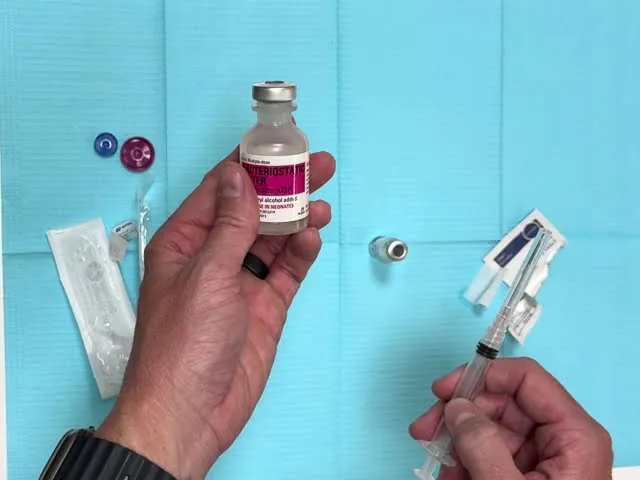
A short walkthrough of reconstituting a lyophilized vial.

Reading the syringe

One unit is 0.01 mL.

The syringe is marked in units, and every unit is one hundredth of a milliliter. Ten units are 0.1 mL; one hundred are 1 mL.

The unit never changes with the barrel. Twenty units are 0.2 mL on a 0.3, 0.5 or 1 mL syringe; a larger syringe simply holds more of them.

  • 0.3 mL30 units
  • 0.5 mL50 units
  • 1 mL100 units

The arithmetic

Three lines of arithmetic.

Every figure the calculator shows comes from three relationships. They are written out here so any result can be checked by hand, and so no number has to be taken on faith.

Concentration
concentration (mg/mL) = vial contents (mg) ÷ solvent volume (mL)
The vial holds a fixed total. More solvent spreads that total across more milliliters, so the concentration falls; less solvent raises it.
Volume
volume (mL) = amount (mg) ÷ concentration (mg/mL)
This is the volume that holds a stated amount. An amount in mcg is divided by 1,000 first, because 1 mg is 1,000 mcg.
Syringe reading
U-100 units = volume (mL) × 100
One unit is 0.01 mL, so the reading is the volume multiplied by 100. The barrel size changes how many units fit, never what a unit is.

Worked examples

Three vials, worked by hand.

The figures are round on purpose. Each example shows how the three lines connect and nothing more. None is a suggested amount, and other numbers work the same way.

A 10 mg vial and 2 mL of solvent

The vial and 2 mL of solvent give 5 mg/mL. A volume of 0.1 mL then holds 0.5 mg, which reads as 10 units on a U-100 scale.

Concentration
10 mg ÷ 2 mL = 5 mg/mL
Volume
0.5 mg ÷ 5 mg/mL = 0.1 mL
Reading
0.1 mL × 100 = 10 units

A 5 mg vial and 2.5 mL of solvent

The vial and 2.5 mL of solvent give 2 mg/mL. A volume of 0.25 mL holds 0.5 mg, which reads as 25 units. The same 0.5 mg took 0.1 mL in the first example; this solution is 2.5 times less concentrated, so the volume is 2.5 times larger.

Concentration
5 mg ÷ 2.5 mL = 2 mg/mL
Volume
0.5 mg ÷ 2 mg/mL = 0.25 mL
Reading
0.25 mL × 100 = 25 units

A 20 mg vial, 2 mL of solvent and an amount in mcg

The vial and 2 mL of solvent give 10 mg/mL. A stated 250 mcg is 0.25 mg, so it occupies 0.025 mL, which reads as 2.5 units. That is halfway between two whole units, so it is judged by eye and carries more relative error than the other two.

Concentration
20 mg ÷ 2 mL = 10 mg/mL
Convert
250 mcg ÷ 1,000 = 0.25 mg
Volume
0.25 mg ÷ 10 mg/mL = 0.025 mL
Reading
0.025 mL × 100 = 2.5 units

Limits

What this calculator does not do.

It does arithmetic on the numbers you type, and nothing else. It does not suggest amounts, protocols or uses, and it cannot know what a vial holds beyond the figure you read from its label.

It keeps nothing. The values stay on this page, and reloading clears them. There is no account, no saved vial and no history.

Material supplied by Astral is for laboratory research only. A result here is a sum, not guidance. Check any figure that matters against the label and the certificate of analysis for the lot in hand.
Questions

Questions about the math.

What do I enter in each field?

Three numbers. Vial contents is the amount printed on the label, in mg. Solvent added is the solvent volume, in mL. The third is the amount to measure, in mcg or mg. The reading follows from those three and nothing else.

Why is one unit 0.01 mL?

A U-100 scale divides 1 mL into 100 equal units, so one unit is one hundredth of a milliliter. The scale is a convention for reading volume. It says nothing about what the solution contains, so 10 units are 0.1 mL whatever is dissolved in it.

What changes when the solvent volume changes?

The vial holds the same total, so the concentration changes in proportion. Doubling the solvent halves the mg/mL, and the volume that holds a given amount doubles with it. Halving the solvent does the reverse. Only the number of milliliters the total is spread across changes.

Why does the calculator accept both mcg and mg?

Labels and certificates use both. Because 1 mg is 1,000 mcg, the calculator converts the amount to mg before it divides, so 250 mcg becomes 0.25 mg. Switching the unit on the field converts the number you typed, so the quantity stays the same.

What do the syringe sizes change?

Only how many units fit. A 0.3 mL barrel holds 30 units, a 0.5 mL barrel holds 50 and a 1 mL barrel holds 100. The calculator warns when a reading is more than the chosen barrel holds, because a sum can be right while the volume still does not fit.

How does the calculator handle a blend?

Each component is worked on its own. A component’s concentration is its own mg figure from the label divided by the same solvent volume. A blend labeled 5 mg and 5 mg in 2 mL is 2.5 mg/mL of each component and 5 mg/mL in total. Enter one component’s label figure as the vial contents to read that component.

How precise can a reading be at very small volumes?

Less precise as the volume shrinks. A syringe has a finite number of marks, and a reading between two of them is judged by eye. An error of half a unit is 5% of a 10-unit reading and 25% of a 2-unit one. The calculator flags any result under one unit. More solvent lowers the concentration, which turns the same amount into a larger volume with a smaller relative error.

Does the calculator store what I type?

No. The arithmetic runs in your browser, and nothing you enter is saved or sent anywhere. Reloading the page clears every field.

Read next

Method, storage, solvent, record.

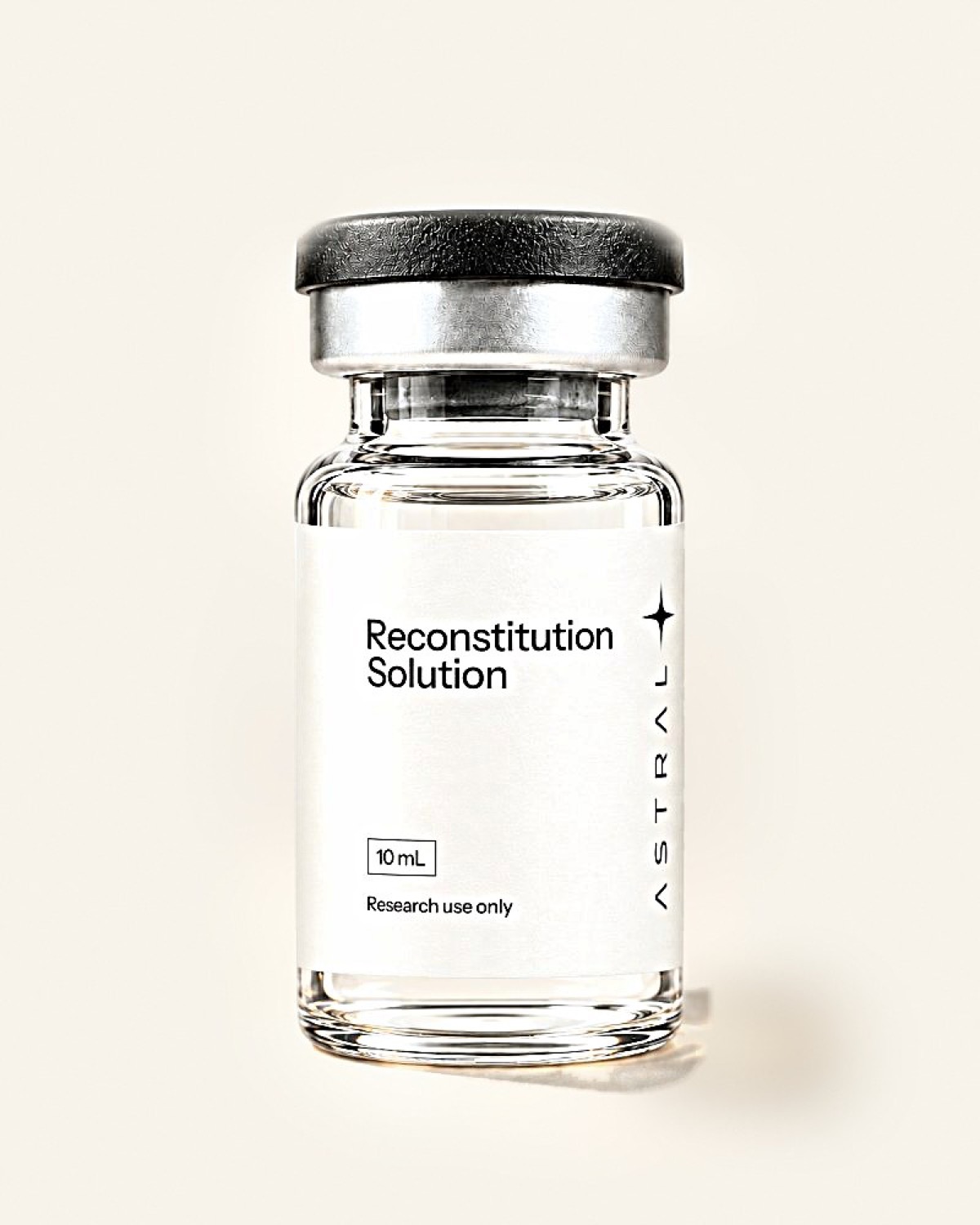
Reconstitution Solution, Astral research vial

The solvent, on the shelf.

Bacteriostatic water with 0.9% benzyl alcohol, supplied for laboratory reconstitution.

View the solution