Wolverine peptide stack: BPC-157 and TB-500 explained
What BPC-157 and TB-500 are, how the two differ, why they share a vial, and how Wolverine compares with GLOW and KLOW.
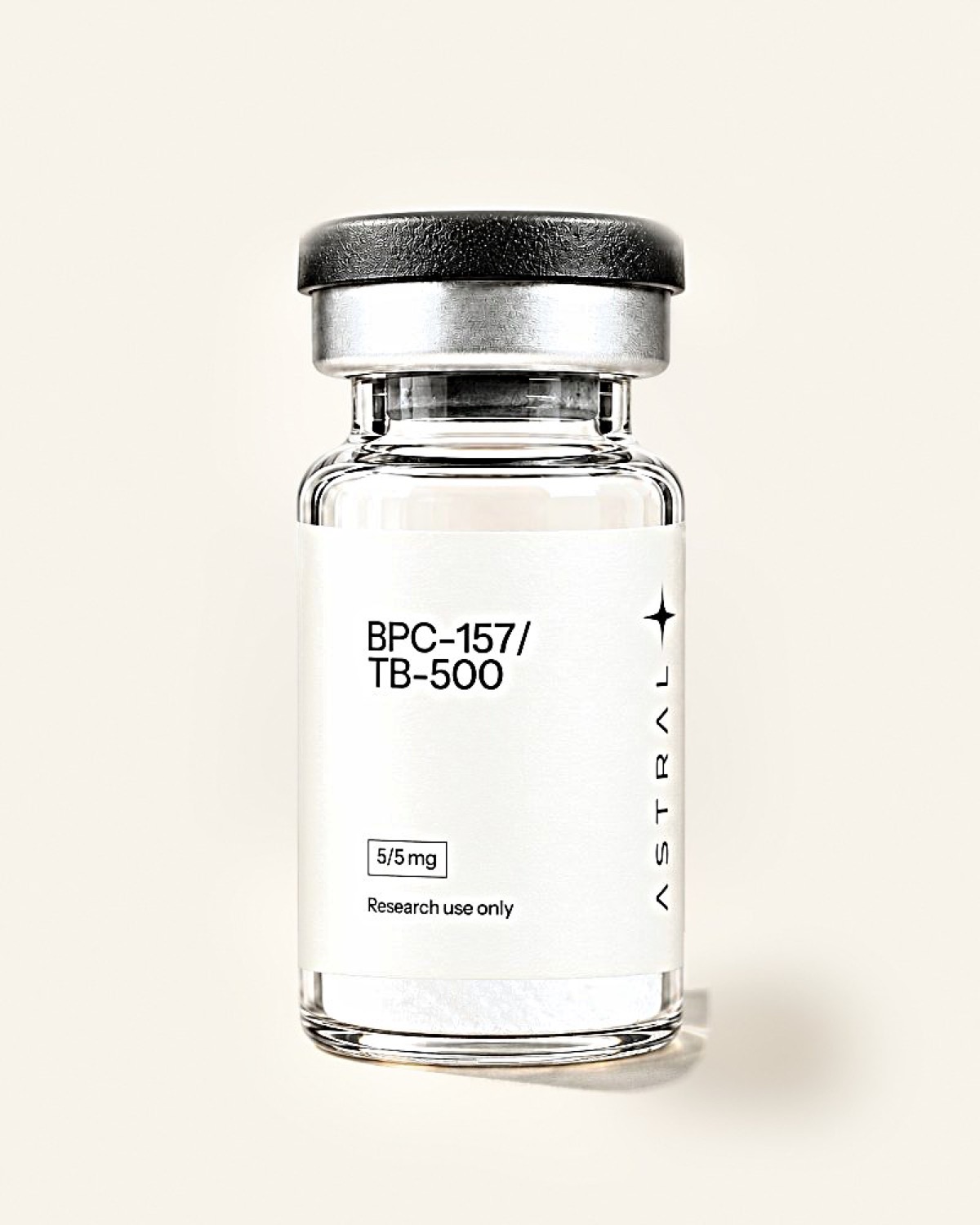
The Wolverine peptide stack is two peptides, BPC-157 and TB-500, freeze-dried together in one vial. Astral’s Wolverine comes in two sizes, 5/5 mg and 10/10 mg, meaning 5 mg or 10 mg of each peptide. The name borrows the comic-book hero who heals from almost anything, a nod to what both peptides are best known for in the lab: tissue repair in animal and cell models.
You will see the same pairing written as “Wolverine stack,” “BPC-157 and TB-500” or “BPC TB blend.” All of them mean these two peptides in one vial. Here is what each one is, where they differ, and why they so often travel together.
Table of contents
What is in the Wolverine stack?
Two peptides in equal amounts, dissolved together and freeze-dried into a single powder. The one-to-one ratio is fixed when the vial is filled, so every vial of a given size carries exactly the same split.
| Component | 5/5 mg vial | 10/10 mg vial |
|---|---|---|
| BPC-157 | 5 mg | 10 mg |
| TB-500 | 5 mg | 10 mg |
| Total peptide | 10 mg | 20 mg |
Once the powder is in solution the two cannot be pulled apart. A design that needs different amounts of each starts from the single vials instead: BPC-157 and TB-500, 10 mg each.
What is BPC-157?
BPC stands for “body protection compound.” BPC-157 is a synthetic chain of 15 amino acids, Gly-Glu-Pro-Pro-Pro-Gly-Lys-Pro-Ala-Asp-Asp-Ala-Gly-Leu-Val, whose sequence comes from a protein found in human gastric juice. It also goes by the code PL-14736. CAS 137525-51-0, molar mass 1419.56 g/mol.
Most of the work on BPC-157 comes from one research group in Zagreb, Croatia, which has published on it since the 1990s. A 2003 study in the Journal of Orthopaedic Research cut the Achilles tendon in rats and reported faster healing in the BPC-157 group, along with faster growth of tendon cells in a dish. A 2014 paper in Molecules found that it raised growth hormone receptor levels in rat tendon cells. A 2025 systematic review in the HSS Journal, covering its use in orthopedic and sports research, found the evidence almost entirely preclinical, from animals and cells.
What is TB-500?
TB-500 is a lab-made peptide related to thymosin beta-4, a 43-amino-acid protein found in nearly every cell in the body. Thymosin beta-4’s day job is managing actin, the protein a cell uses to change shape and move. A 1997 study in Biochemistry mapped how it wraps around a single actin unit and holds it in reserve.
That link to cell movement is why thymosin beta-4 shows up in repair research. When tissue is damaged, cells have to travel into the injury to rebuild it. A widely cited 2004 study in Nature found that thymosin beta-4 helped heart cells migrate and survive, and supported cardiac repair, in mice after a heart injury. As with BPC-157, nearly all of this work is in animals and cells.
BPC-157 vs TB-500: how do they differ?
| BPC-157 | TB-500 | |
|---|---|---|
| Origin | A sequence from a gastric juice protein | Related to thymosin beta-4, a repair protein in almost every cell |
| Length | 15 amino acids | Related to a 43-amino-acid protein, thymosin beta-4 |
| Research focus | Tendon, ligament and gut tissue, and new blood vessel growth | Cell movement, wound repair and heart tissue |
| Best-known finding | Faster Achilles tendon healing in rats | Heart cell migration and survival in mice |
| Sold on its own | Yes, 10 mg | Yes, 10 mg |
In short, BPC-157’s research centers on the injured tissue itself and the blood supply around it. TB-500’s centers on getting cells to the injury in the first place. One is about the site, the other about the traffic.
Why are BPC-157 and TB-500 paired?
Because their research lines cover different ground. Put the two in one vial and a single solution touches both the tissue-and-blood-vessel side and the cell-movement side of repair biology. That is the whole idea behind the stack.
A single vial with a fixed ratio and one label is also simpler to store, reconstitute and track than two. No published study has tested the pair together, so the case for the combination rests on what each peptide has shown on its own.
Wolverine vs GLOW vs KLOW
The three blends build on each other. GLOW is the 10/10 mg Wolverine pair plus 50 mg of GHK-Cu, the copper peptide. KLOW is GLOW plus 10 mg of KPV, the three-amino-acid peptide covered in What is KPV peptide?. Our GLOW explainer and KLOW vs GLOW cover those two in depth.
| Blend | Contents | Total |
|---|---|---|
| Wolverine 5/5 | BPC-157 5 mg, TB-500 5 mg | 10 mg |
| Wolverine 10/10 | BPC-157 10 mg, TB-500 10 mg | 20 mg |
| GLOW | GHK-Cu 50 mg, BPC-157 10 mg, TB-500 10 mg | 70 mg |
| KLOW | GHK-Cu 50 mg, BPC-157 10 mg, TB-500 10 mg, KPV 10 mg | 80 mg |
Storage and reconstitution
Cold, dry, dark and sealed until you mix it. Freeze-dried powder keeps for years in a freezer and a year or two in a refrigerator, and the peptide storage guide lays out each window. Let a cold vial reach room temperature before opening it, so no condensation lands on the powder.
Each peptide gets its own concentration once liquid goes in. Add 2 mL of Reconstitution Solution to a 10/10 mg vial and you have 5 mg/mL of BPC-157 and 5 mg/mL of TB-500 in the same solution. The peptide calculator does the division for any vial size and volume, and How to reconstitute peptides has the steps. Once mixed, keep it in the refrigerator at 2 to 8 °C.
Common questions
Why is it called the Wolverine stack?
After the comic-book character known for healing from almost any injury. Both peptides in the blend are best known for tissue-repair research, so the nickname stuck.
Is the Wolverine stack the same as BPC-157 and TB-500?
Yes. “Wolverine,” “Wolverine stack” and “BPC-157 and TB-500” all describe the same two peptides in one vial, usually 5 mg or 10 mg of each.
What sizes does Wolverine come in?
Astral’s Wolverine comes in 5/5 mg and 10/10 mg vials, 10 mg and 20 mg of total peptide.
How is Wolverine different from GLOW?
GLOW is the 10/10 mg Wolverine pair plus 50 mg of GHK-Cu, for 70 mg in all. Wolverine holds only BPC-157 and TB-500.
Can I buy BPC-157 and TB-500 separately?
Yes. BPC-157 and TB-500 are each sold on their own in 10 mg vials, which suits a design that needs a ratio other than one to one.
Has the BPC-157 and TB-500 combination been studied?
Not as a pair. Each peptide has its own body of animal and cell research, and no published study has tested the two together.
Sources
- Gastric pentadecapeptide BPC 157 accelerates healing of transected rat Achilles tendon and in vitro stimulates tendocytes growth Staresinic M, Sebecic B, Patrlj L, et al. Journal of Orthopaedic Research (2003)
- Pentadecapeptide BPC 157 enhances the growth hormone receptor expression in tendon fibroblasts Chang CH, Tsai WC, Hsu YH, Pang JH. Molecules (2014)
- Emerging Use of BPC-157 in Orthopaedic Sports Medicine: A Systematic Review Vasireddi N, Hahamyan H, Salata MJ, et al. HSS Journal (2025)
- Thymosin beta 4 binds actin in an extended conformation and contacts both the barbed and pointed ends Safer D, Sosnick TR, Elzinga M. Biochemistry (1997)
- Thymosin beta4 activates integrin-linked kinase and promotes cardiac cell migration, survival and cardiac repair Bock-Marquette I, Saxena A, White MD, et al. Nature (2004)